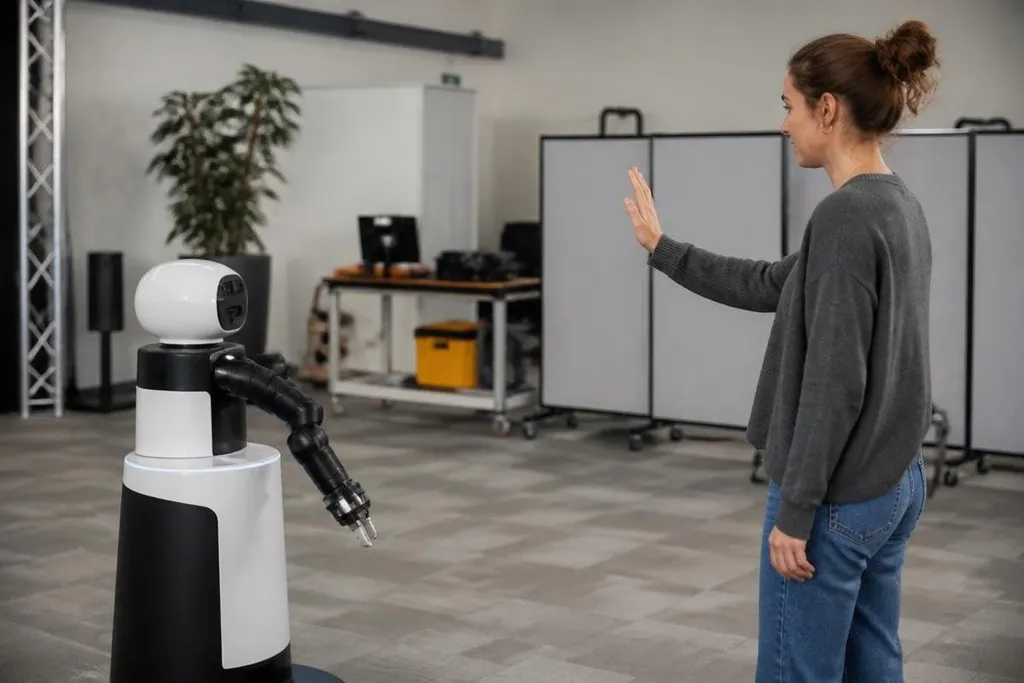
Robots can read a raised hand, a turned head, or a person stepping back. They do this with cameras, motion data, and rules that connect body position to likely intent. The hard part is knowing what the movement means in a busy room.
Quick read
- RGB cameras record body shape and movement.
- Depth sensors add distance, so the robot can place a person in 3D space.
- Meaning comes from context, timing, and safety rules rather than one gesture alone.
From pixels to body parts
The robot starts with an image from an RGB camera. Software marks points such as the head, shoulders, elbows, wrists, hips, knees, and feet. This group of points is often called a body pose.
Those points give the robot a map of movement. A raised wrist appears above the shoulder. A turned torso changes the line between the shoulders and hips. A foot moving away from the robot can show that the person is leaving the work area.
A depth camera adds distance to those points. That lets the robot tell the difference between a hand close to its arm and a hand farther across the room. The result is a rough 3D model, not a perfect digital copy of the person.
The robot checks several frames instead of relying on one image. A single frame can show a person with one arm raised because they are waving, reaching for a shelf, or trying to keep balance.
The next few frames help separate those actions.
How movement gets meaning
Pose data becomes useful only after the robot links it to a task. In a shared work area, a person facing the robot with one hand raised may be asking it to stop. The same hand position near a shelf may mean the person is reaching for an object.
Head direction adds another clue. If the head points toward the robot while the arm moves, the robot may treat the gesture as a request. If the head points toward a colleague, the same arm movement may belong to a conversation instead.
Timing also matters. A hand that stays raised for several frames is easier to classify than a hand seen at the top of a quick swing. Robot software can compare the pose, the direction of motion, and the distance between the person and the machine before it chooses an action.
This process resembles a set of checks rather than human instinct. The robot assigns a likely meaning, then applies rules for the task.
A safety rule can tell it to slow down when a person steps inside a marked zone, even if the system cannot tell why they moved.
Where the system struggles
Body language changes across people and places. A tall person and a seated person produce different joint positions. Loose clothing can hide elbows and knees. Poor light, blocked views, and several people standing close together can also break the pose estimate.
Gestures carry different meanings across cultures and work teams. A system trained to treat a palm facing the camera as “stop” needs that rule set clearly. It should not assume that every movement has one meaning everywhere.
The system also has a narrow view of human intent. It can measure a hand position or head angle, but it cannot read a person’s private thoughts from posture alone. A pause may mean confusion, caution, or a network delay in the robot’s task.
I’d trust body signals to support a safety rule, not to make a high-stakes decision alone.
That limit matters in factories, hospitals, and public spaces. The machine can slow down when a person moves close, then ask for a clear button press or spoken command before it starts again. A second signal gives the machine a better basis for action.
A body-language claim needs a recorded task behind it. Human-robot interaction reports can show whether a robot reacts to a raised hand or a person stepping into its path. The useful report names the robot and records response time or false alarms before developers measure the system.
What developers can measure
Teams can test body-language systems by checking the actions that matter in one setting. They may compare the robot’s reading with marked video frames, then record false stops, missed gestures, and delays before a response.
The test needs a clear task. A warehouse robot may need to spot a person entering its path. A service robot may need to tell a wave from a hand reaching toward a tray. Those are different problems, even though both use pose data.
A good system also shows its reason in a form a technician can inspect. The log might record the person’s distance, the detected hand position, the action selected, and the safety rule that caused the stop. That record helps staff fix a bad rule instead of guessing at the cause.
A practical check before deployment
Use this short guide before relying on body language in a robot task:
- Name the gesture: write down the movement the robot must detect and the action that follows.
- Add a second signal: pair posture with distance, head direction, a button, or speech.
- Test blocked views: place people behind carts, beside one another, and near doorways.
- Set a safe default: stop or slow the robot when the meaning remains uncertain.
- Log each decision: save the pose data, response, and rule used for later checks.
These steps keep body pose in its proper place. It can help a robot respond to people, but clear commands and safety controls still carry the final decision.
The open question is how well these systems will work across crowded spaces, different clothing, and changing social habits without adding false stops to daily work.